
Kasey Cromer, Netlok | June 9, 2026
In 2026, the most dangerous entry point in your organization is no longer a misconfigured firewall or an unpatched server. It is a phone call, a Microsoft Teams message, or a support ticket. According to Palo Alto Networks Unit 42, social engineering is now the top initial access vector globally, present in 36% of all incidents tracked between May 2024 and May 2025. And once an attacker gains that foothold, they are no longer operating at human speed. Mandiant’s M-Trends 2026 report found that the median time between initial access and handoff to a ransomware operator has collapsed from over eight hours in 2022 to just 22 seconds in 2025. In practice, defenders have seconds, not hours, to detect and respond.
Enterprises are responding by automating the helpdesk entirely. AI-powered support agents now handle a large share of IT requests autonomously. But this shift does not eliminate the social engineering threat. It transforms it. The same manipulation that convinced a human helpdesk agent to reset a multi-factor authentication (MFA) device can now be used to convince an AI agent to do the same thing at machine scale.
The only defense that breaks this cycle permanently is not better training for humans or smarter guardrails for AI. It is removing the credential reset as an attack surface entirely. Photolok by Netlok is built for exactly that outcome.
The IT helpdesk has become one of the most valuable targets for hackers in enterprise security. It sits at the intersection of identity management and operational urgency, with the authority to reset passwords, de-register MFA devices, and provision emergency access. That combination makes it irresistible to attackers.
The playbook is straightforward. An attacker gathers basic information about an employee from LinkedIn, public records, or data exposed in previous breaches. They call the helpdesk pretending to be that employee — a technique known as voice phishing (vishing) — cite an urgent situation, and ask for a credential reset or a new MFA device enrollment. In many organizations, a convincing story and a few verifiable details are enough to get the request approved.
Scattered Spider, the threat cluster responsible for the MGM Resorts breach in 2023, used exactly this technique. An operative impersonated an employee over the phone, convinced the helpdesk to clear active MFA devices, and registered their own phone as the trusted authentication device on the account. That single conversation opened the door to ransomware deployment that cost MGM over $100 million in remediation and lost revenue.
The threat has escalated significantly since then. AI-generated voice clones now allow attackers to match the voice profiles of specific executives with alarming accuracy. Real-time deepfake video wrappers can defeat organizations that require employees to appear on camera during support calls. The Health Sector Cybersecurity Coordination Center has issued specific warnings about campaigns where attackers called hospital helpdesks from localized area codes, presented verified employee data including IDs and dates of birth scraped from prior breaches, and requested credential overrides before security teams could respond.
According to the ISACA 2026 Tech Trends and Priorities report, based on a survey of 3,000 IT and cybersecurity professionals, AI-driven social engineering is now the top cybersecurity threat organizations expect to face, cited by 63% of respondents. This is the first time it has topped the ISACA findings, surpassing ransomware at 54% and insider threats at 35%.
The reason this threat is so persistent is structural. As long as the helpdesk retains the authority to reset credentials, attackers will find a way to exploit it.
Faced with rising ticket volumes and lean security teams, enterprises are moving quickly to automate internal IT support. ServiceNow’s $2.85 billion acquisition of Moveworks and the subsequent launch of its Autonomous Workforce platform represents the most visible signal of this shift. AI specialists now resolve a large share of IT and customer support requests end to end, without human involvement.
This automation delivers real operational value in cost and response time. But it does not eliminate the social engineering attack surface — it simply moves it from the call center to the AI agent’s chat window. When the first responder to a locked-out employee is an AI agent, the attack vector shifts from a voice call to a text string. Prompt injection — embedding hidden instructions inside a message to trick an AI into executing unauthorized commands — is ranked the number one risk in the Open Worldwide Application Security Project (OWASP) Top 10 for Large Language Model Applications, and exploits the same vulnerability that human social engineering does: trust. An AI agent does not get suspicious. It cannot sense that a story sounds wrong. A successful injection exploit requires a carefully crafted text string, and once discovered, it can be replicated across thousands of accounts simultaneously.
The pace of modern attacks makes this especially dangerous. Mandiant’s M-Trends 2026, based on more than 500,000 hours of incident response investigations, found that the median time between initial access and handoff to a ransomware group has collapsed to just 22 seconds. With an AI agent processing requests at machine speed, there is no window for second thoughts.
Solving this requires changing what the helpdesk is allowed to touch in the first place. Organizations that automate their helpdesk without rethinking the credential reset workflow are not solving the problem. They are automating their exposure.
The standard response to helpdesk social engineering has been to train humans to be more skeptical and to engineer AI systems to be harder to manipulate. Both approaches are necessary. Neither is sufficient.
Human awareness training reduces susceptibility but cannot eliminate it. Helpdesk staff are trained to be helpful, and that helpfulness is exactly what attackers exploit. They engineer fabricated scenarios to create urgency and iterate constantly as organizations update their verification procedures.
For AI systems, prompt injection guardrails and input validation are important baseline controls. But the attack surface is enormous. AI helpdesk agents ingest data from support tickets, chat logs, email portals, and knowledge bases — every one a potential injection vector. The OWASP guidance acknowledges that defending against prompt injection comprehensively remains an unsolved problem.
Both approaches share the same flaw: they assume the helpdesk must retain authority to reset credentials. The correct strategic response is to eliminate the target, not to fortify it indefinitely.
The most effective way to break the helpdesk social engineering attack sequence is to eliminate the prize the attacker is hunting. If there is no password to reset, the vishing call has no payload and the prompt injection string has no credential to harvest. Photolok by Netlok is a passwordless identity provider that sits at the identity layer and integrates with platforms like Okta Workforce, replacing passwords with photo-based authentication and removing the fixed credential that helpdesk social engineering is designed to obtain.
Photo-based authentication: Users identify images from a personal photo panel rather than entering a password. Because authentication is based on visual recognition of private images rather than recall of a text string, the most common categories of a helpdesk ticket — forgotten passwords, expired credentials, account lockouts from character errors — are removed from the environment entirely. There is no credential for a social engineer to request, and no reset process to manipulate.
1 Time Photo: Users can configure up to five single-use photos for authentication. When a 1 Time Photo is active, only the designated single-use panel appears during login. Regular photos stay hidden. Once the 1 Time Photo is used, it is immediately invalidated and cannot be reused. Even if an attacker observes a session, records the screen, or uses a remote access tool during a support interaction, the credential captured has no replay value whatsoever.
Duress Photo: Users can select up to two rotating photos with the Duress label. If an employee is pressured into authenticating under coercion, selecting a Duress Photo triggers a real-time alert to security teams the moment it is chosen. The attacker sees a completed login. The security operations center receives an immediate distress signal. If both a Duress Photo and a 1 Time Photo are active, both appear on the first photo panel together.
This last capability addresses something no password, passkey, or biometric system provides. Traditional credentials are passive — they cannot communicate whether the person entering them is acting freely or under duress. Photolok’s Duress Photo gives employees a safe way to signal danger while appearing to comply, matching the real-time velocity of modern attacks.
For organizations deploying AI helpdesk systems, Photolok changes the calculus entirely. When there is no password in the environment, an AI agent has nothing to reset and prompt injection attacks targeting credential workflows lose their operational value.
The helpdesk social engineering threat will not be resolved by incremental improvements to verification procedures or AI guardrails. It requires a structural change to how identity is managed. These steps can move an organization in the right direction.
Social engineering has survived every enterprise defense upgrade for a simple reason: the asset it targets has never changed. As long as there is a credential to reset and a helpdesk with the authority to reset it, attackers will find a way to exploit that process. Better training, stricter verification, and smarter AI all raise the cost of the attack. None of them remove the incentive.
In 2026, with attack handoff times measured in seconds and AI enabling social engineering at industrial scale, organizations cannot afford to keep defending a credential infrastructure that was designed for a different era.
Photolok eliminates passwords at the identity layer, removes the credential reset from the helpdesk workflow, and gives security teams a real-time signal when an employee is authenticating under duress. It does not make the helpdesk more resilient. It makes the helpdesk irrelevant as an attack surface.
The conversation attackers are counting on cannot happen if the elements they are after do not exist.
Request Your Personalized Demo
About the Author
Kasey Cromer is Director of Customer Experience at Netlok.
Sources
[1] Palo Alto Networks Unit 42. ‘2025 Global Incident Response Report: Social Engineering Edition.’ July 2025. unit42.paloaltonetworks.com
[2] Google Threat Intelligence Group / Mandiant. ‘M-Trends 2026.’ March 2026. mandiant.com
[3] ISACA. ‘2026 Tech Trends and Priorities Pulse Poll.’ October 2025. isaca.org
[4] ServiceNow. ‘ServiceNow Completes Moveworks Acquisition.’ December 2025. servicenow.com
[5] OWASP. ‘OWASP Top 10 for Large Language Model Applications.’ January 2026. owasp.org
[6] Health Sector Cybersecurity Coordination Center (HC3). ‘Social Engineering Threats Targeting Healthcare IT Helpdesks.’ 2025. hhs.gov/hc3
[7] CISA. ‘Scattered Spider Threat Advisory.’ 2025. cisa.gov
[8] Netlok. ‘How Photolok Works.’ netlok.com
Kasey Cromer, Netlok | May 27, 2026
In 2026, security leaders are being asked to defend more with less. The global cybersecurity workforce gap has reached 4.8 million unfilled positions, and AI upskilling is helping organizations stretch leaner teams further. But even the most capable, AI-assisted security team cannot overcome a broken front door. Passwords remain one of the most expensive, most exploited, and most friction-heavy elements in enterprise security. The answer is not a longer, more complex password. It is no password at all.
Photolok by Netlok is a passwordless identity provider built for this environment. It simplifies how employees log in, removes passwords from the equation entirely, and gives security teams the tools they need to protect people, not just credentials. For lean, AI-assisted teams managing complex identity surfaces, that combination is not just convenient: it is strategic.
The cybersecurity talent crisis is no longer a projection. According to the ISC2 2025 Cybersecurity Workforce Study, there are an estimated 4.8 million unfilled cybersecurity positions globally. The World Economic Forum estimates that the industry would need to grow its workforce by 87% just to meet current demand. The financial consequences are concrete: IBM’s 2025 Cost of a Data Breach Report found that organizations with significant staffing shortages paid an average of $1.76 million more per breach than their better-staffed counterparts.
Many organizations are responding by investing in AI-powered security tools and upskilling existing staff. IBM’s 2025 Cost of a Data Breach Report found that organizations making extensive use of security AI and automation saved an average of $1.9 million per breach compared to those that did not, and reduced their breach lifecycle by an average of 80 days. AI is giving lean teams real leverage.
But AI cannot deliver its full potential if security teams are buried under preventable, low-value work. Password resets, account lockouts, MFA confusion, and access change requests consume a disproportionate share of IT and security attention every single day. For lean teams, every hour spent on password support pulls attention from threat detection and leaves a growing backlog of the strategic work that AI tools are meant to free them up to do.
Addressing front-end authentication demands is not just about employee experience improvement. It is a cost and risk reduction strategy for AI-assisted security teams.
Most organizations have never calculated the true cost of their password infrastructure. When they do, the number is rarely small.
Forrester Research puts the average cost of a single helpdesk password reset at $70. Gartner estimates that 20% to 50% of all helpdesk calls are password-related. In large enterprises, this adds up to more than $5 million annually in password reset costs alone. Forrester Research estimates that employees spend an average of 11 hours per year on password-related tasks. In a company of 15,000, that translates to more than $5 million annually in lost productivity — before accounting for a single helpdesk call.
That number does not include the broader cost of digital friction. WalkMe’s 2026 State of Digital Adoption report, based on a survey of 3,750 executives and employees across 14 countries, found that workers now lose the equivalent of 51 working days per year to technology friction, up 42% from 2025.
The security risk compounds the operational cost. Phishing and stolen credentials consistently rank among the most common and costly initial access vectors in IBM’s annual breach research. Every password that exists is a credential that can be phished, guessed, stolen, or reused. And every reset process is an opportunity for a social engineering attack. The widely reported MGM Resorts breach in 2023 began with a social engineering call to the helpdesk. The technique works because helpdesk staff are trained to be helpful, and verifying identity over the phone is genuinely difficult to do with exact certainty.
The instinct in enterprise security has long been to fight password risk with more complexity — longer strings, more special characters, requirements to change passwords every 30, 60, or 90 days, and unique requirements for every system. In practice, this approach increases cost without meaningfully reducing risk.
As password requirements become more demanding, reset volume and lockout rates increase — because complex passwords are harder to remember, and employees who forget them have no choice but to reset or get locked out. NIST’s updated password guidelines confirm this directly, noting that complexity requirements lead to user frustration and more frequent resets, not stronger security. The predictable result is that more employees reuse passwords across systems, store them insecurely, share credentials to avoid being locked out or call support more often. These behaviors are not failures of awareness. They are rational responses to a system that asks too much.
For lean security teams, complexity-only strategies deliver the worst possible outcome: higher operational burden and sustained risk. The answer is not a harder password. It is a better system.
Biometrics and passkeys both represent real progress beyond passwords. But in 2026, neither is sufficient as a standalone authentication strategy.
iProov’s 2025 Threat Intelligence Report documented a 2,665% increase in virtual camera attacks and a 300% surge in face-swap attacks — techniques that use AI-generated faces and voices to fool identity verification systems into granting access as if a real, authorized person were present. The same biometric trait that was once considered uniquely yours is now a liability if it is publicly available.
Passkeys are a significant step forward in eliminating password reuse and phishing risk, but they carry their own limitations in enterprise environments. Device dependency creates complexity around lost, stolen, or replaced hardware. Shared workstations, common in healthcare, manufacturing, and retail, do not map cleanly to individual passkeys. Recovery flows often reintroduce the social engineering risks that passkeys were designed to eliminate.
Critically, neither biometrics nor passkeys have a built-in notion of duress. If a user is coerced into authenticating under threat, the system has no way to help the user. The login looks legitimate. Access is granted. And the security team has no signal that anything is wrong.
Photolok is a passwordless identity provider that sits at the identity layer, not the SaaS application layer. It integrates with platforms like Okta Workforce and replaces passwords entirely with photo-based authentication that is both simpler for users and harder for attackers to exploit.
Photo-based authentication. Users identify images from a photo panel rather than entering a password. These photos are not publicly available and cannot be predicted or replicated by AI. There is nothing to phish, nothing to crack, and nothing to share insecurely.
1 Time Photo. Users can configure up to five single-use photos for authentication. When a 1 Time Photo is active, only the first panel appears during login and the user’s standard login photos remain hidden. Once used, the photo cannot be reused. Even if an attacker records the session or captures the screen, they gain no usable knowledge about a person’s login photos. There are no patterns for AI to learn and no value in replaying what was captured.
Duress Photo. Users can configure up to two Duress Photos. If a user is forced to authenticate under coercion, selecting a Duress Photo triggers a real-time alert to security teams the moment it is chosen. The person doing the coercing sees a normal login. The security team sees an immediate distress signal.
This is a capability that passwords, passkeys, and biometrics do not provide. It protects the person behind the credential, not just the credential itself.
The shift to passwordless authentication does not happen overnight, but security leaders can take concrete steps today.
In 2026, the cybersecurity workforce gap is not closing fast enough to rely on headcount alone. AI upskilling is giving lean teams real leverage, but only if the operational environment supports it. Passwords are one of the most persistent sources of cost, friction, and risk in enterprise security, and complexity-only strategies have proven they cannot fix the underlying problem.
Photolok eliminates passwords entirely, simplifies the login experience for employees, and gives security teams something no password, passkey, or biometric system provides: a real-time signal when someone is authenticating under duress.
Leaner teams deserve better tools. And better tools start with a better front door.
Request Your Personalized Demo
About the Author
Kasey Cromer is Director of Customer Experience at Netlok.
Sources
[1] ISC2. ‘2025 Cybersecurity Workforce Study.’ 2025. isc2.org
[2] World Economic Forum. ‘Global Cybersecurity Outlook 2026.’ January 2026. weforum.org
[3] IBM. ‘Cost of a Data Breach Report 2025.’ 2025. ibm.com/reports/data-breach
[4] WalkMe. ‘State of Digital Adoption 2026.’ April 2026. walkme.com
[5] Forrester Research. ‘The Total Economic Impact of Passwordless Authentication.’ 2024. forrester.com
[6] CIO. ‘The Hidden Costs of Your Helpdesk.’ February 2025. cio.com
[7] iProov. ‘Threat Intelligence Report 2025.’ January 2025. iproov.com
[8] Netlok. ‘How Photolok Works.’ netlok.com
[9] NIST. ‘Digital Identity Guidelines: Authentication and Authenticator Management (SP 800-63B-4).’ 2025. csrc.nist.gov
Kasey Cromer, Netlok | May 13, 2026
As we move through 2026, the corporate world is facing an existential crisis of trust. The ‘identity surface’ has exploded, but the tools we use to defend it are crumbling under the weight of generative AI. For years, we relied on the human eye and ear as the ultimate backstop for security. We believed that if we could see a person’s face, hear their voice, or provide the correct password or codes, we knew who they were.
That era is over.
Today, deepfakes allow bad actors to impersonate anyone — from a frontline support agent to the CFO — with terrifying precision. Legacy authentication methods like biometrics and SMS codes were never designed to withstand AI powered impersonation. To survive this era, executives and investors must stop viewing identity as an application feature and start viewing it as a foundational layer. Photolok provides that layer, offering a visual identity solution that remains resilient even when faces and voices can no longer be trusted.
In early 2024, global engineering firm Arup’s Hong Kong office lost approximately $25 million after an employee joined a video conference where every other participant — including the CFO — was a deepfake. The attacker used AI generated video and audio to convincingly simulate multiple executives and authorize a series of fraudulent transfers.
(Source: CNN, February 2024, SCMP initial report, February 2024, SCMP follow‑up naming Arup, May 2024, CNN follow‑up naming Arup, May 2024)
At the time, many viewed this as an outlier. By 2026, it has become a standard tactic.
Several high profile incidents since then illustrate how quickly synthetic identity attacks have matured:
What changed between then and now is scale, cost, and realism.
According to CrowdStrike’s 2026 Global Threat Report, AI powered impersonation attacks increased by 89% year over year from 2024 to 2025, with continued acceleration into 2026.
The FBI’s Internet Crime Complaint Center (IC3) reported that business email compromise alone accounted for over $3 billion in losses in 2025, with total cyber crime losses exceeding $20 billion — a 26% increase from the prior year.
This is no longer about isolated fraud attempts. It is a systemic shift. Attackers are no longer breaking into systems — they are manipulating people first through social engineering, then using that legitimate access to exfiltrate sensitive data at machine speed, not human speed.
The same technology targeting CFOs is now targeting your employees at home. In 2026, deepfake celebrity scams on Facebook and TikTok have become industrialized — AI generated videos of Taylor Swift promoting fake investment schemes, doctors appearing to endorse miracle cures. According to Surfshark, celebrity and public figure impersonations account for more than half of all financial damage linked to deepfakes. Employees conditioned to trust video content in their personal lives carry that assumption into the workplace. When a deepfake ‘executive’ calls with an urgent request, the instinct is to comply — because seeing has always meant believing.
The industry is now confronting what can be described as the biometric paradox. For years, biometrics were positioned as the gold standard because they were ‘uniquely you.’ In 2026, that uniqueness is a liability.
Publicly available data — social media videos, earnings calls, podcast appearances — provides the perfect training set for AI systems to replicate voice and facial patterns.
The numbers reinforce how quickly this model is breaking. Across recent reports, a consistent pattern emerges:
Meanwhile, attackers who flood users with repeated MFA approval requests create fatigue that overrides caution — and continue to succeed because the vulnerability is human, not technical. When combined with a convincing deepfake voice or video, even security aware employees comply.
Traditional identity and access management was built for a world of static credentials and human users. It has no answer for synthetic voices, fabricated video, or AI generated impersonation.
We are entering a period where ‘seeing is believing’ is no longer just outdated — it is dangerous.
This erosion of trust creates friction across every business function:
Microsoft’s Digital Defense Report highlights that nation state groups are already experimenting with synthetic media for influence and intrusion campaigns.
When the visual layer is compromised, the entire remote work security model begins to collapse.
To solve this, we must address a fundamental misunderstanding in the cybersecurity industry.
There is a critical distinction the security industry often fails to make: identity providers are not applications. An identity provider is the system that verifies who you are before you ever touch an application. It issues the proof of identity that connected applications rely on. Photolok is an identity provider — not just another tool in the SaaS portfolio, but the layer that sits beneath all of them.
The average enterprise now manages more than 305 SaaS (software as a service) applications. (Source: Okta Businesses at Work Report, January 2026) When identity is treated as just another app within that sprawl, it fails. Identity is not an app — it is the layer beneath the apps.
This distinction matters more in the AI era because SaaS apps are multiplying rapidly, AI agents are becoming new identity actors, and authentication must happen before any interaction with systems or agents.
Photolok is a passwordless identity provider built for a world where biometrics can be faked. It meets 2026 standards for phishing resistant authentication while adding something most identity tools ignore: protection for the person, not just the credential. Photolok integrates with platforms like Okta Workforce and acts as the secure front door for your online environment. Users must prove who they are before accessing any application or interacting with AI systems.
Photolok shifts authentication away from public, replicable signals toward private, human knowledge that AI cannot infer.
The shift to AI driven impersonation requires more than incremental fixes. It requires rethinking how identity is verified across the organization.
Each of these steps addresses a different failure point exposed by AI driven impersonation — not just technical vulnerabilities, but human ones.
In 2026, the identity surface is the new perimeter.
As attackers use AI to manufacture trust and exfiltrate sensitive data at machine speed, not human speed, organizations must respond with identity systems designed for this new reality.
Photolok represents a shift away from spoofable biometrics and toward private, human centered authentication. It restores trust not by improving detection, but by changing what is being verified.
We are no longer just protecting systems. We are protecting people. And in an era where anyone can be faked, that distinction matters more than ever.
Request Your Personalized Demo
Kasey Cromer is Director of Customer Experience at Netlok.
[1] CrowdStrike. ‘2026 Global Threat Report.’ February 2026. crowdstrike.com/global-threat-report
[2] Adaptive Security. ‘Voice Cloning Threat Report.’ 2026. adaptivesecurity.com
[3] Microsoft. ‘Digital Defense Report 2025.’ October 2025. microsoft.com
[4] IRONSCALES. ‘Fall 2025 Threat Report: Beyond Detection.’ October 2025. ironscales.com
[5] FBI IC3. ‘2025 Internet Crime Report.’ February 2026. ic3.gov
[6] Pindrop. ‘Voice Intelligence Report.’ March 2026. pindrop.com
[7] Mandiant. ‘M-Trends 2026.’ November 2025. mandiant.com
[8] Okta. ‘Businesses at Work Report.’ January 2026. okta.com
[9] DeepMedia. ‘State of Deepfake Detection.’ February 2026. deepmedia.ai
[10] iProov. ‘Threat Intelligence Report 2025.’ January 2025. iproov.com
[11] Surfshark. ‘Deepfake Statistics.’ 2025. surfshark.com
[12] Netlok. ‘How Photolok Works.’ netlok.com
Kasey Cromer, Netlok | April 29, 2026
In 2026, most enterprises are running more applications than they can realistically govern, and AI is accelerating the problem. Zylo’s 2026 SaaS Management Index reports that the average organization manages 305 SaaS (software as a service) applications and spends $55.7 million annually on SaaS apps. Even though the number of SaaS apps being used appears flat at roughly 300 tools per organization, the specific apps inside that portfolio are constantly changing as teams add, replace, and experiment with new tools. AI‑native applications, in particular, are growing at more than 100 percent year over year, driving significant app turnover and creating a major challenge for IT to keep up, while multiplying the identity surface where accounts, credentials, and tokens can be abused.
AI itself has gone mainstream. Netskope’s 2025 Generative AI Report shows that 98 percent of organizations use apps with AI features, while 90 percent use generative AI apps. Among those organizations, the volume of data sent to genAI apps has increased more than thirtyfold over the past year. This combination of app sprawl and AI powered functionality has created a sprawling, often ungoverned identity surface where every account, credential, and token becomes another way in. CrowdStrike’s 2026 Global Threat Report confirms: cloud focused intrusions increased 37 percent over last year, and valid account abuse now drives 35 percent of cloud incidents.
The answer to intrusion is not yet another standalone security product. It is a dedicated identity provider (IdP) linked with an authentication server that can deliver phishing resistant, passwordless authentication across this entire landscape and protect the person behind the account.
Over the past decade, SaaS has become the default way to deliver business capabilities. Finance, HR, marketing, engineering, sales, and operations all run on specialized applications that are easy to procure and constantly updated. Zylo’s 2026 data shows where this ends up: the typical enterprise now uses 305 SaaS applications, and that count has effectively plateaued at a very high level.
However, “plateaued” does not mean stable. Within large organizations, teams still add an average of 21 new applications each month, often chasing new features and AI capabilities, while removing an equal number of “outdated” apps. Average SaaS spend has climbed to $55.7 million per year, up 8 percent even without a meaningful increase in app count, as AI native tools and usage based pricing push costs higher.
Shadow IT magnifies this complexity. Lansweeper’s 2025 research finds that 42 percent of company applications exist outside formal approval. Even worse, the average company now has 975 cloud services untracked by IT, compared to just 108 known services tracked by IT, which means roughly 90 percent of cloud services are effectively invisible to central teams.
Employee behavior reinforces the trend. According to 1Password’s Access Trust Gap report, 52 percent of employees have downloaded apps without IT approval, and 42 percent bypass IT specifically to boost productivity. Yet every unsanctioned app that asks for credentials or OAuth tokens becomes another entry point for bad actors that the organization does not control. Even where organizations have invested in single sign on (SSO), coverage is incomplete: 30 to 34 percent of applications are not protected by SSO at all. That is the environment into which AI has arrived.
AI is no longer a side project; it is now a core part of daily work. Microsoft’s AI Economy Institute reports that by late 2025, 16.3 percent of people globally were using generative AI tools, with usage in advanced economies reaching 24.7 percent of the working age population. Many of those people are employees asking AI to draft content, analyze data, or write code.
Netskope’s 2025 Generative AI Cloud and Threat Report shows what this looks like at the application level. Netskope tracks 317 distinct genAI apps across its customer base and reports that the amount of data sent to genAI in prompts and uploads has increased more than 30 fold in a year, including source code, regulated data, intellectual property, and secrets.
The governance story is more troubling. While 90 percent of organizations use genAI apps, roughly 72 percent of genAI use in enterprises is classified as shadow AI. That means only 28 percent is company‑approved, with the rest driven by employees using personal accounts, free tiers, and unsanctioned tools. 1Password’s research shows that 73 percent of employees say they are encouraged to use AI, but roughly a third admit they do not always follow AI policies.
From an attacker’s perspective, this environment is ideal. AI assistants and copilots are often granted wide permissions so they can read mailboxes, browse documents, search code repositories, or update CRM records on behalf of users. If a bad actor can obtain a valid credential or compromise an OAuth token, they can operate as the user or as the AI agent with very little friction and can exfiltrate sensitive data at machine speed, not human speed.
CrowdStrike’s 2026 Global Threat Report confirms this is already happening. Cloud focused intrusions increased by 37 percent, with a 266 percent increase among nation-state threat actors. At the same time, 1Password observes that enterprises now have 82 to 144 non human identities for every human identity, including service accounts, API keys, SaaS bots, and AI agents. Traditional IAM was never designed for that ratio.
Most organizations did not design their IAM strategies for a world with 300 plus SaaS applications, hundreds of genAI tools, and more than 100 machine identities for each person. They built their strategies for a smaller number of core systems and human users who logged in a few times a day.
SaaS security posture management (SSPM) tools emerged to help, but they tackle a different problem: configuration and policy hygiene inside each SaaS application. Those controls matter, but they do not change how a user proves who they are and they do not stop attackers from abusing valid credentials.
The governance gap is clear in the data. The Cloud Security Alliance’s 2025 State of SaaS Security report shows that 58 percent of organizations struggle to enforce privileges, 54 percent lack automation for identity lifecycle management, and 46 percent struggle to monitor non human identities. Meanwhile, 66 percent of employees admit to poor password habits, and compromised credentials remain the primary cause of 53 percent of substantial breaches. MFA fatigue attacks compound the problem. Traditional IAM cannot keep up with app sprawl and AI driven identity risk.
In this environment, “yet another security SaaS app” is not the answer. The key question is not “Which app can we buy to protect our apps?” but “How do we shift security back to the identity layer?”
Identity providers (IdP) are the first login step in Identity and Access Management (IAM) solutions and are not Software as a Service (SaaS) programs. Unfortunately, the cybersecurity industry has failed to explain this critical difference, which causes confusion among online users. An identity provider (IdP) is the identity system that verifies who a user is and issues trusted tokens that applications use for access decisions. IdP systems include passwords, biometrics, passkeys, etc. SaaS programs include common programs like Office 365, financial software, calendars, video games, etc.
Photolok is an emerging passwordless identity provider (IdP) designed to meet 2026 industry standards for phishing resistant authentication while adding capabilities that protect the person, not just the user’s credentials. Photolok sits at the identity layer, integrates with existing identity providers such as Okta Workforce, and becomes the place where users prove who they are before accessing SaaS applications, AI tools, and AI agents. Instead of creating more app sprawl, Photolok acts as the secure front door for your online environment, simplifying and standardizing how the user can logon safely across their app sprawl.
Photo based authentication across all apps. Photolok replaces passwords with photo based authentication that can be applied across all of your applications. Because Photolok sits at the identity layer, this authentication can be integrated with your existing SSO and Okta Workforce policies rather than implemented separately for each app.
1 Time Photo: defending against AI powered credential capture. With 1 Time Photo, users can create up to five single use photos for authentication. When a 1 Time Photo is active, only the first panel is shown during login — the user’s regular photos never appear on screen. Once used, a 1 Time Photo cannot be reused, and an attacker who captures the screen or records the session gains no knowledge of the user’s standard photo set.
Duress Photo: protecting the person in coercion scenarios. Photolok’s Duress Photo gives employees a way to signal danger even when they are forced to authenticate. Duress Photo is a special visual panic button that looks like a normal login but acts as a silent alarm that sends an alert to IT and security teams. If a user is coerced to log in, the Duress Photo alerts responders while not tipping off the person doing the coercing. This is a human safety and duty of care capability that IAM tools do not address.
Simplified authentication that reduces fatigue. Photolok provides point and click interactions, autosaves where appropriate, and integrates with Okta Workforce. By consolidating authentication into a single phishing resistant flow, you can reduce password fatigue and MFA fatigue across your entire app portfolio.
Your challenge is to reassert control at the identity layer without undermining the productivity gains that SaaS and AI deliver. The following practices can help.
In the age of AI, apps have become a primary security risk not because any single SaaS tool is uniquely dangerous on its own, but because together they create an identity surface that is too large and too dynamic for traditional IAM to manage alone. Threat actors have already adapted: cloud focused intrusions and valid account abuses are rising sharply, and compromised credentials drive 53 percent of substantial breaches while a third of apps remain outside SSO.
The strategic move is to consolidate authentication at the identity layer with a phishing resistant identity provider that works across your SaaS and AI environment. Photolok is an emerging passwordless identity provider and authentication server designed to meet 2026 industry standards while adding capabilities that protect the person, not just the account. By integrating with Okta Workforce, applying photo based authentication, 1 Time Photo, and Duress Photo across apps, Photolok helps you regain control of the identity and authentication surface without fighting the tide of app and AI adoption. To fully realize that benefit, you also need a program focused on discovering shadow IT and onboarding those apps to your primary identity provider.
The question for security leaders is no longer whether app and AI sprawl will happen — it already has. The question is whether your identity layer is ready for the world you are already in.
Request Your Personalized Demo
Kasey Cromer is Director of Customer Experience at Netlok.
[1] Zylo. “2026 SaaS Management Index.” February 2026. zylo.com
[2] Lansweeper. “Effective Shadow IT Management in 2025.” June 2025. lansweeper.com
[3] 1Password. “Annual Report 2025: The Access Trust Gap.” October 2025. 1password.com
[4] 1Password. “AI and the Rise of Credential Sprawl.” April 2026. 1password.com
[5] Netskope. “Cloud and Threat Report: Generative AI 2025.” March 2026. netskope.com
[6] Microsoft AI Economy Institute. “Global AI Adoption in 2025.” April 2026. microsoft.com
[7] CrowdStrike. “2026 Global Threat Report.” March 2026. crowdstrike.com
[8] Cloud Security Alliance. “The State of SaaS Security: 2025–2026.” April 2025. cloudsecurityalliance.org
[9] Netlok. “How Photolok Works.” netlok.com
Kasey Cromer, Netlok | April 10, 2026
Geopolitical escalation reliably coincides with surges in phishing, credential theft, and identity abuse, especially where state sponsored actors target workers in defense, critical infrastructure, and technology supply chains. Newly released 2026 findings from leading threat intelligence teams show that attackers increasingly “log in” with stolen credentials, reused passwords, or credentials from coerced employees instead of “breaking in” with exploits or malware.
Across these reports, identity has effectively become the primary attack surface, with valid account abuse, social engineering, and misused login processes driving a large share of initial access. Agencies and large vendors now describe phishing resistant authentication as the gold standard for protecting high value accounts and urge enterprises to phase out legacy MFA that depends on passwords, one time codes, or generic push approvals.
At the same time, the industry is shifting from a narrow focus on protecting accounts to a broader mandate to protect the person behind those accounts. This blog examines that identity crisis, compares common identity and access management (IAM) approaches, and introduces Photolok’s photo based, phishing resistant authentication as an example of how to protect both the account and the individual.
Over the past decade, multiple conflicts have shown that geopolitical escalation and cyber campaigns move in lockstep. State sponsored groups consistently use phishing and credential theft as low cost, high yield tactics to gain footholds in targeted environments.
Newly published findings from Palo Alto Networks Unit 42 show that identity abuse has become the dominant pathway into enterprises. Their Global Incident Response Report 2026, based on 2025 investigations, reports that identity based techniques accounted for nearly two thirds of initial intrusions, and that identity weaknesses played a significant role in nearly 90 percent of investigations. This underscores that many modern attacks begin with misuse of legitimate access, not exploitation of software flaws.
In parallel, early 2026 reporting from Google’s threat intelligence team, analyzing campaigns observed through 2025, highlights sustained pressure on the defense industrial base from Russia and China linked actors. These campaigns often go after individual employees rather than network defenses, using spear phishing, fake recruitment efforts, and other social engineering to reach both corporate and personal accounts. Enterprises become downstream targets even when they are not directly party to a geopolitical flashpoint.
Newly released 2026 threat reports, analyzing 2025 activity, emphasize that intrusions are increasingly identity based. Large incident response and threat intelligence teams describe campaigns where adversaries focus on obtaining valid credentials, abusing login sessions, and hijacking login processes instead of exploiting unpatched vulnerabilities.
CrowdStrike’s 2026 Global Threat Report shows a sharp rise in cloud focused attacks. According to the report’s newly released 2026 findings on 2025 activity, cloud focused attacks increased by 37 percent, and state sponsored attackers driving these intrusions increased their activity by 266 percent. Valid account abuse accounts for roughly 35 percent of cloud incidents, underscoring that many attacks now start with a login rather than an exploit.
Mandiant’s M Trends 2026 report, based on 2025 incidents, underscores how quickly attackers can use stolen credentials. The report notes that the median time between initial access and passing that access to another attacker has fallen to just 22 seconds. Once an attacker gains a foothold using stolen identity data, they can immediately pass that access to other actors, compressing defenders’ window to detect and contain a breach.
Analysis of MFA fatigue campaigns published in early 2026, reflecting 2025 trends, shows attackers exploiting human overload rather than technical weaknesses. Organizations report sustained waves of push prompts and social engineering calls that pressure users into approving malicious sign ins. Even where multifactor authentication is present, adversaries look for ways to turn user behavior into a vulnerability.
Facing this identity focused threat environment, major vendors and agencies are reorienting their strategies around the idea that identity is the new perimeter. Microsoft’s Secure Future Initiative guidance positions phishing resistant authentication as essential for reducing credential based risk. As of mid 2025, Microsoft reported that 92 percent of employee productivity accounts were protected by phishing resistant methods, and 2026 guidance treats this as a baseline for modern enterprises rather than a stretch goal.
Okta’s 2026 guidance on phishing resistant authentication likewise recommends phishing resistant authentication as non-negotiable for high value accounts. They urge organizations to enroll administrators and sensitive users into hardware security keys, smart cards, or other device based methods, and to reduce reliance on SMS, email codes, and generic push notifications that can be abused in vishing (voice phishing) and MFA fatigue attacks.
CISA and aligned industry commentary describe phishing resistant multi factor authentication as the gold standard for high assurance access, and point to hardware security keys and certificate based login methods as primary mechanisms to achieve it. Phishing resistant authentication is treated as a foundational requirement in modern security frameworks, not an optional enhancement.
Despite this progress, there is a growing recognition that protecting accounts is not enough. Google’s early 2026 analysis of 2025 campaigns notes that state sponsored actors deliberately target personnel through personal devices, personal email accounts, and recruitment platforms, not just enterprise systems. Yet mainstream IAM platforms and standards still lack built in duress signals that allow a user to complete a login under threat while silently requesting help.
Against this backdrop, security leaders are being asked to make choices among several common authentication approaches, each with its own tradeoffs.
Passwords. Familiar and widely supported, but highly phishable, frequently reused across sites, vulnerable to credential stuffing (attackers using stolen passwords across multiple sites), and expensive to reset at enterprise scale.
SMS and email MFA. Adds a second factor beyond passwords, but phishable via fake login pages, exposed to SIM swapping (hijacking phone numbers), and often kept as a backup login method that undermines stronger methods.
Push based MFA. Convenient and user friendly, but susceptible to MFA fatigue and vishing, where attackers bombard users with prompts or call them to persuade approval.
Passkeys and FIDO2. Phishing resistant and passwordless by design, backed by major platforms. However, they require compatible hardware, create challenges around recovery and portability, and do not offer an inherent duress signal if a user is coerced.
Photolok. Photo based, phishing resistant, passwordless login that replaces static text credentials with user selected images. Includes 1 Time Photo and duress capabilities designed to protect the person as well as the account.
During periods of geopolitical escalation, these tradeoffs determine whether state sponsored actors can turn social engineering into valid logins.
This gap between where the industry is headed (phishing resistant, passwordless, tied to specific devices) and what attackers are exploiting (human behavior, coercion, and backup login methods) defines the identity crisis: enterprises are modernizing authentication but often still leave the person exposed.
Photolok is an emerging passwordless identity provider designed to meet 2026 industry standards for phishing resistant authentication while adding capabilities that protect the person, not just the account. Instead of typing usernames and passwords, users authenticate by selecting their account photos from a randomized photo panel.
Netlok positions Photolok as a solution that meets the 2026 industry standard for phishing resistant authentication and goes further by addressing coercion, visual credential theft, and person level safety.
Treat geopolitical escalation as an automatic trigger for stronger authentication. Tie specific geopolitical or sector advisories to predefined changes in authentication policy, such as enforcing phishing resistant methods for affected users, tightening session lifetimes, and increasing monitoring of high value accounts.
Measure phishing resistance, not just MFA coverage. Move beyond reporting “percentage of users with MFA” and explicitly track what share of workforce access uses phishing resistant methods versus passwords with legacy MFA. Focus first on administrators, developers, and business users who can move money, change configurations, or access sensitive data.
Assess whether your IAM stack protects the person. Review your identity and access vendors for capabilities that address the human layer: protections on personal devices and personal email, detection of unusual sign in behavior, and any mechanisms that allow users to signal duress during login. Identify where your current stack assumes the user is always safe and in control.
Model coercion and visual credential theft as explicit identity threats. Add scenarios involving shoulder surfing, screen recording, MFA fatigue, vishing, and physical coercion into your identity threat modeling. Ask, “If an employee is forced to log in in front of someone, or harassed with prompts until they approve, what options does our current authentication give them?”
Brief leadership on the shift from protecting accounts to protecting people. When you talk to executives and boards, frame identity risk as a human safety problem, not just a technical one. Explain that state sponsored actors now go after employees as individuals, often outside corporate networks, and that investing in phishing resistant, person aware authentication is part of protecting both company assets and staff.
Geopolitical tensions will continue to drive spikes in credential theft, identity abuse, and downstream attacks on enterprises, especially in sectors tied to defense, critical infrastructure, and technology supply chains. Newly released 2026 threat reports, documenting 2025 activity, reinforce that most intrusions now begin with some form of identity misuse, and that the window between credential theft and active exploitation is shrinking.
In response, agencies and major vendors are converging on phishing resistant, passwordless authentication as the standard for high value access. But phishing resistance alone does not solve for coercion, duress, and the reality that employees themselves are being targeted and pressured. To resolve this identity crisis, organizations need authentication that protects the person as well as the account — combining phishing resistant methods with features like visual shielding and duress signaling.
Request Your Personalized Demo
Kasey Cromer is Director of Customer Experience at Netlok.
[1] CrowdStrike. “2026 Global Threat Report: AI Accelerated Adversaries.” February 23, 2026. crowdstrike.com
[2] Palo Alto Networks Unit 42. “Global Incident Response Report 2026.” February 16, 2026. cyberscoop.com
[3] Industrial Cyber. “Identity Loopholes Drive Nearly 90% of Unit 42 Investigations.” February 19, 2026. industrialcyber.co
[4] Mandiant. “M Trends 2026 Report.” March 23, 2026. helpnetsecurity.com
[5] Google Cloud. “Threats to the Defense Industrial Base.” February 9, 2026. cloud.google.com
[6] Microsoft. “Phishing Resistant MFA (Secure Future Initiative).” August 2025. learn.microsoft.com
[7] Okta. “Why Basic MFA Isn’t Enough to Defeat Modern Phishing.” January 14, 2026. okta.com
[8] IDDataWeb. “Inside CISA’s Phishing Resistant MFA Playbook.” August 2025. iddataweb.com
[9] SentinelOne. “What Is Phishing Resistant MFA?” March 1, 2026. sentinelone.com
[10] The Hacker News. “9 Identity Security Predictions for 2026.” February 8, 2026. thehackernews.com
[11] Smarter MSP. “MFA Fatigue Continues to Be a Threat in 2026.” January 26, 2026. smartermsp.com
[12] Netlok. “How Photolok Works.” netlok.com
Kasey Cromer, Netlok | March 31, 2026
Executive Summary
Traditional authentication was designed to answer one question: should this login succeed? It was not designed to ask whether the person behind the login is safe. In 2026, that gap is becoming a liability.
Attackers are no longer just stealing credentials. They are threatening employees in person, harvesting login data by watching screens, and exploiting the sheer complexity of enterprise identity systems to slip through undetected. The threats have become personal, but the defenses have not kept pace.
This blog examines three 2026 realities that 1) demands a “protect the person, not just the account” mindset; 2) explains why traditional authentication falls short, and; 3) outlines what security leaders can do now to close the gap.
Three 2026 Realities Security Leaders Must Address
1. Protecting the person and account
2. Why Traditional Authentication Falls Short
Traditional authentication systems were built to verify identity, not to protect the person behind it. They have no mechanism for an employee to signal that they are being coerced. They rely on credentials that can be observed, captured, and replayed. They add friction through multiple factors without reducing the underlying exposure.
The core assumption that the person logging in is doing so freely and privately, no longer holds in many real world scenarios. When a teller is threatened, when a phone is stolen, when someone watches you type your password in an airport, traditional MFA does nothing to help.
3. How Photolok Addresses the “Protect the Person” Gap
Photolok Passwordless IdP was designed with these realities in mind. It replaces passwords with photo based authentication that addresses coercion, observation, and complexity at the identity layer:
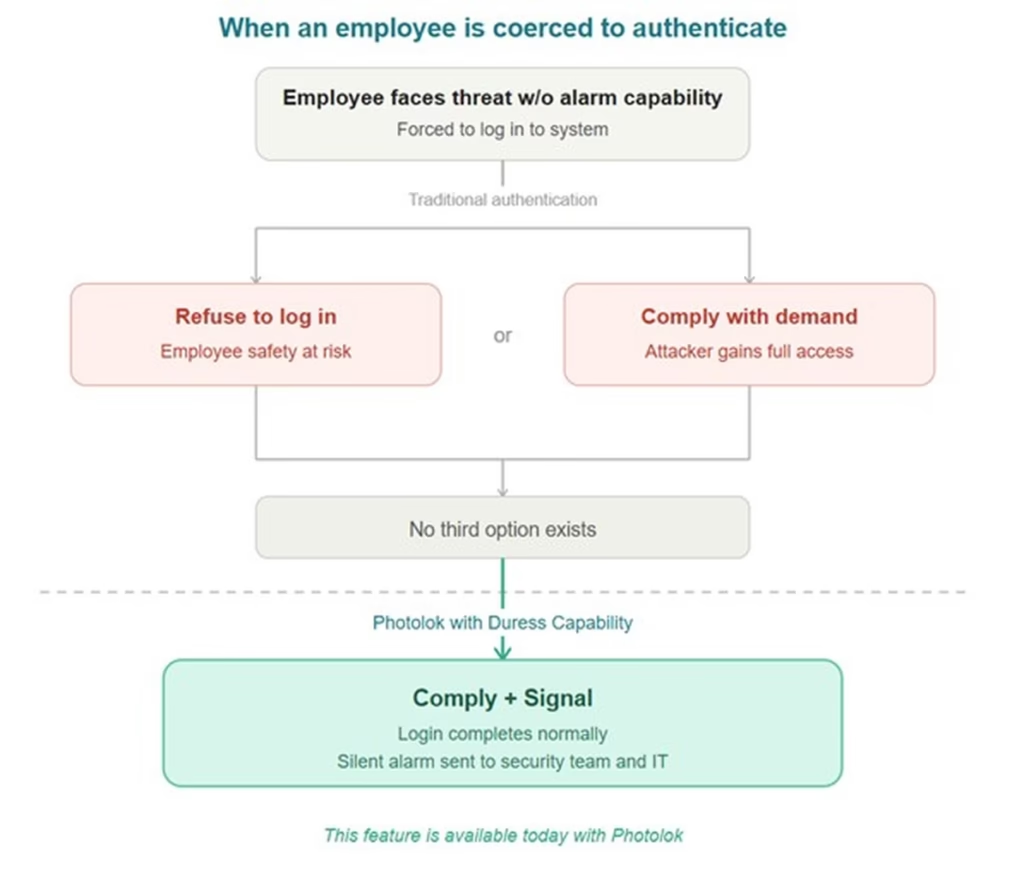
Figure: Traditional authentication offers only two paths during coercion. Photolok creates a third.
Because Photolok sits at the identity provider and authentication layer, it complements existing security controls without requiring a redesign of downstream systems.
What Security Leaders Should Do Now
Establish duress protocols across security, IT, HR, and physical safety teams. Coercion scenarios do not fit neatly into IT incident response. Work with HR, legal, and workplace safety stakeholders to define what happens when an employee signals distress during authentication. Who gets notified? What access gets constrained? How is the employee protected?
Add coercion and device theft scenarios to incident response playbooks. Most playbooks cover phishing and malware. When an employee is physically threatened, the first priority is personal safety, followed by immediately disabling their account access and coordinating across security, HR, and physical safety teams. When a laptop is stolen with active sessions, response must happen in minutes: log out all devices, reset passwords, and remotely erase the device. Document the response steps now, before you need them.
Implement a credential reset policy after travel or public exposure. Employees who work in airports, conferences, coffee shops, or client sites are at elevated risk for shoulder surfing. Consider requiring credential rotation or one time use authentication for sensitive systems after travel.
Review remote wipe and device lockdown procedures. When a phone or laptop is stolen, how quickly can you revoke access? Test your identity provider integrations to ensure you can lock out a compromised device within minutes, not hours.
Evaluate whether your authentication gives employees any way to protect themselves. Ask a simple question: if an employee is being coerced right now, does your authentication system give them any option other than compliance or refusal? If the answer is no, explore solutions that build human safety into the authentication flow.
The Bottom Line
In 2026, identity is personal. Attackers target people, not just accounts, through coercion, device theft, and the noise of sprawling identity systems. Traditional authentication was built to decide whether a login should succeed, not whether the human behind it is safe.
The organizations that adapt will be those that treat “protect the person, not just the account” as a design principle for every authentication decision they make.
Request Your Personalized Demo
About the Author
Kasey Cromer is Director of Customer Experience at Netlok.
Sources
[1] CENTEGIX. “Healthcare Safety Trends Report 2026.” centegix.com
[2] Campus Safety. “How Wearable Panic Buttons Will Improve Hospital Workplace Safety in 2026.” campussafetymagazine.com
[3] Crisis24. “Increasing Rates of Phone Thefts Worldwide Pose Significant Data Security Risks.” crisis24.com
[4] Kensington. “Study Highlights Prevalence of Device Theft and the Impacts on Data Security.” kensington.com
[5] SpyCloud. “2026 Identity Exposure Report.” prnewswire.com
[6] 1Password. “Credential Sprawl: How AI Increases the Risks.” 1password.com
[7] GitGuardian. “The State of Secrets Sprawl 2026.” gitguardian.com
[8] Avatier. “Passwordless Security Based Systems.” avatier.com
[9] Thales. “2026 Data Threat Report.” cpl.thalesgroup.com
[10] Netlok. “How Photolok Works.” netlok.com