
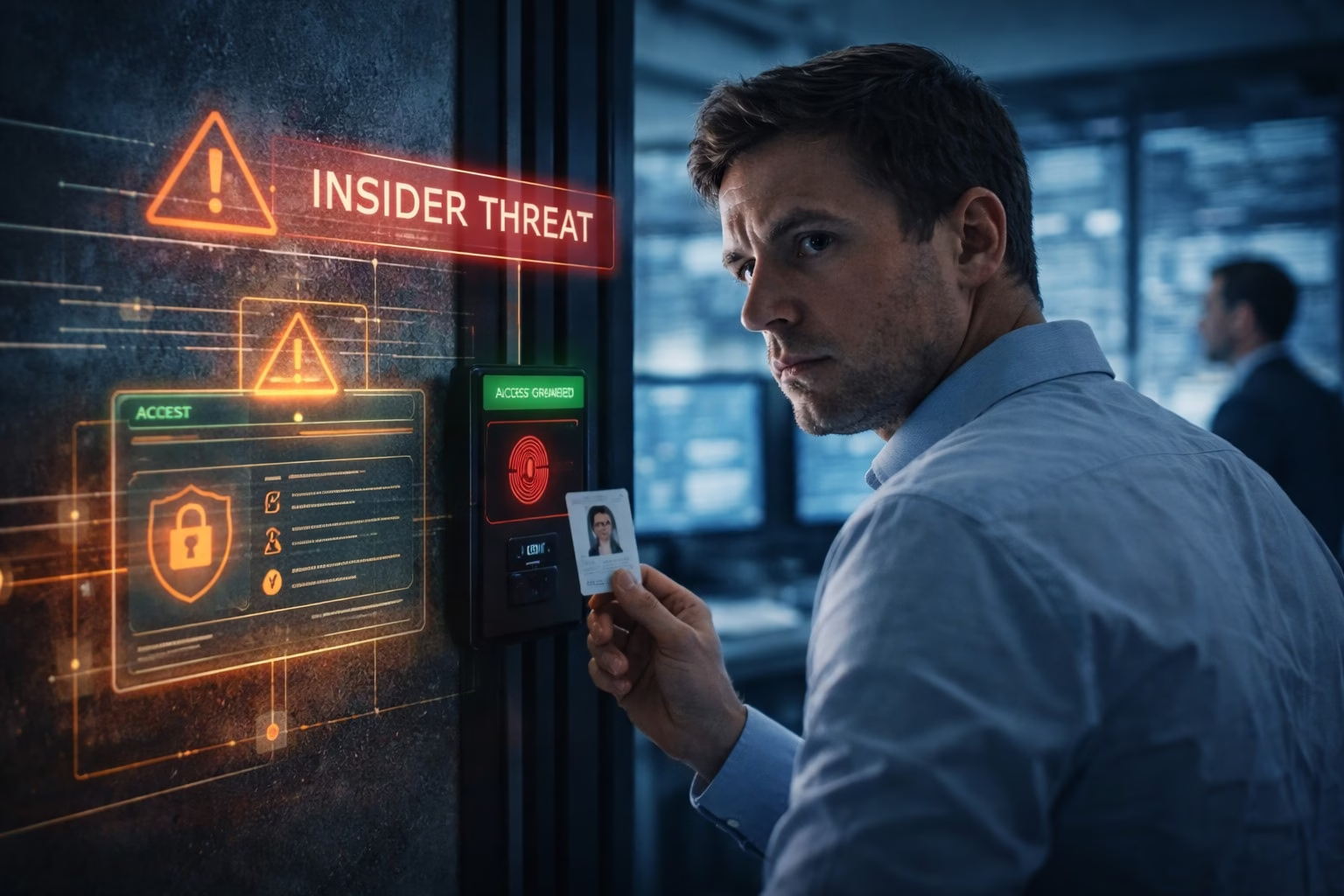
Kasey Cromer, Netlok | January 5, 2026
Executive Summary
Insider threats now cost an average of $17.4 million annually per enterprise, and 93% of security leaders say these attacks are harder to detect than external breaches. The uncomfortable truth: your most significant security vulnerability isn’t a sophisticated hacker probing your perimeter. It’s the trusted employee, contractor, or compromised credential holder who already has the keys to your kingdom. As AI-powered attacks accelerate and traditional authentication methods fail, organizations must fundamentally rethink how they verify identity at the point of access.
Predictions at a Glance
| Metric | Finding | Source |
| Average annual cost of insider incidents per enterprise | $17.4 million | Ponemon Institute 2025 [1] |
| Organizations experiencing insider incidents in past year | 83% | Cybersecurity Insiders 2024 [2] |
| Security leaders who find insider threats harder to detect than external attacks | 93% | Cybersecurity Insiders 2025 [3] |
| Breaches involving stolen credentials | 22% | Verizon DBIR 2025 [4] |
| Average days to detect and contain an insider incident | 81 days | Ponemon Institute 2025 [1] |
| Cost of incidents taking 91+ days to contain | $18.7 million | Ponemon Institute 2025 [1] |
| Organizations confident in preventing insider threats before damage occurs | 23% | Cybersecurity Insiders 2025 [3] |
The Insider Threat Problem Is Getting Worse
When CrowdStrike, one of the world’s leading cybersecurity firms, announced in November 2025 that it had terminated an employee for sharing internal screenshots with hackers, it sent shockwaves through the industry [5]. If a company whose entire business model revolves around stopping breaches can be compromised from within, what chance does the average enterprise have?
The incident wasn’t isolated. The threat group known as Scattered Lapsus$ Hunters reportedly paid $25,000 for the insider’s cooperation, seeking authentication cookies and access to internal dashboards [6]. The attackers didn’t need zero-day exploits or sophisticated malware. They needed one person with legitimate access willing to provide critical information and look the other way.
This is the new reality of enterprise security. According to the World Economic Forum’s Global Cybersecurity Outlook 2025, identity theft has climbed to the top of the agenda, emerging as the primary cyber risk concern for both CISOs and CEOs [7]. The report notes that 72% of respondents say cyber risks have risen in the past year, with identity theft and credential compromise driving much of that increase.
Why Traditional Security Can’t Stop Insiders
The fundamental challenge with insider threats is deceptively simple: insiders already have authorized access. They know where sensitive data lives. They understand your security controls and their blind spots. Traditional perimeter defenses are useless against someone who legitimately belongs inside the perimeter.
The Verizon 2025 Data Breach Investigations Report underscores this vulnerability. Stolen credentials were the initial access vector in 22% of all breaches analyzed, and a staggering 88% of basic web application attacks involved the use of stolen credentials [4]. Once an attacker logs in with valid credentials, even robust firewalls and VPNs become irrelevant.
The detection gap is equally troubling. The 2025 Cybersecurity Insiders report found that 93% of organizations say insider threats are as difficult or harder to detect than external cyberattacks [3]. Only 21% extensively integrate behavioral indicators such as HR signals, financial stress, and psychosocial context into their detection programs. The result? Organizations are watching shadows while the real danger moves unchecked.
The Three Types of Insider Threats Bypassing Your Defenses
Understanding how insiders bypass security requires recognizing the three distinct threat profiles that enterprises face:
The Negligent Insider represents the most common category. According to Ponemon Institute research, 55% of insider incidents stem from employee negligence [1]. These aren’t malicious actors; they’re frustrated workers circumventing clunky security controls to meet deadlines, sharing passwords for convenience, or falling victim to sophisticated phishing attacks. The 2025 cost of negligent insider per incident reached $8.8 million annually.
The Malicious Insider acts with deliberate intent. The cost per malicious insider incident reached $715,366 in 2025 [8]. These individuals exploit their knowledge of internal systems and security measures to steal data, sabotage operations, or sell access to external threat actors as the CrowdStrike case demonstrated.
The Compromised Insider blurs the line between internal and external threats. This rapidly growing category occurs when an employee’s credentials are stolen through phishing, infostealers, or social engineering. The attacker then operates under the guise of a legitimate, trusted user. Verizon’s DBIR found that 54% of ransomware victims had their company domains appear in stolen credential databases, and 40% had corporate email addresses exposed in those same breaches [4].
AI Is Accelerating the Threat
The artificial intelligence revolution has fundamentally altered the threat calculus. The World Economic Forum reports that nearly 47% of organizations view adversarial advances powered by generative AI as their primary concern [7]. AI-driven deepfake technology allows criminals to impersonate individuals with deceptive accuracy, potentially bypassing verification systems that rely on static credentials or predictable biometric patterns.
The 2025 Cybersecurity Insiders report highlights growing concern about AI-enabled insider risks [3]: 60% of organizations are highly concerned about employees misusing AI tools, and the leading worries include deepfake phishing and social engineering (69%), automated data exfiltration (61%), and AI-assisted credential abuse (53%).
Traditional passwords offer no defense against these evolving attacks. AI password crackers can now breach most passwords in seconds and complex ones in minutes. When combined with social engineering techniques, AI tools can decipher credentials far more quickly than earlier systems, making password-based authentication effectively obsolete against determined adversaries.
The Authentication Failure Point
Every insider threat incident shares a common vulnerability: the authentication layer. Whether credentials are stolen through infostealers, purchased on the dark web, or simply observed over a shoulder, the point of entry remains the same. Once past the login gate, insiders have freedom to operate.
The problem with conventional authentication methods is their predictability. Passwords can be guessed, phished, or cracked. SMS-based multi-factor authentication is vulnerable to SIM swapping. Even biometrics present challenges; once compromised, they cannot be changed. The Verizon DBIR explicitly recommends against SMS one-time passwords for MFA, noting their vulnerability to bypass techniques [4].
MFA bypass has become a sophisticated attack category. Techniques like prompt bombing (flooding users with authentication requests until they accept), adversary-in-the-middle attacks (intercepting MFA prompts in real-time), and token theft are becoming standard tools for threat actors. The DBIR found that these MFA bypass techniques appeared in a significant percentage of breach incidents.
A Different Approach: Authentication Designed for the AI Era
Addressing insider threats requires authentication that operates on fundamentally different principles. These systems must be designed from the ground up to resist both human manipulation and AI-powered attacks.
Photolok, developed by Netlok, represents this new paradigm in enterprise authentication. Rather than relying on static secrets that can be stolen or replicated, Photolok replaces passwords with user-selected photos that contain embedded encrypted codes using steganography. And unlike biometrics or static passwords, users can easily update their photos at any time, making credential reset simple and immediate. This approach addresses the core vulnerabilities that make traditional authentication susceptible to insider compromise.
The system’s UltraSafe AI/ML login protection is particularly relevant in today’s threat environment. Photolok leverages the “Picture-Superiority Effect,” the scientifically proven principle that humans remember images far better than text, with randomizing photos and embedded codes every session [9]. Because login selections are based on unique, personally meaningful photos rather than static data or predictable biometric patterns, AI and machine learning tools cannot identify or learn patterns to exploit. Even with large datasets, attackers cannot brute-force or simulate a user’s photo selection.
For organizations concerned about coerced access, a scenario where an insider is forced to authenticate under duress, Photolok offers a unique Duress Photo feature that functions as a visual silent alarm. When an account owner feels endangered or forced to provide access, they can select their designated duress photo. The system grants access normally while simultaneously alerting security administrators that the account may be compromised and the user may need assistance [10].
The 1-Time Use Photo capability addresses another common insider attack vector: shoulder surfing and observation attacks. In public or office environments where screens may be visible, users can designate photos for single-use authentication, defeating replay attacks and making credential theft through observation ineffective.
Building Resilience Against Insider Threats
Effective insider threat management requires more than technology; it demands a comprehensive approach that combines preventive controls with detective capabilities. The Ponemon Institute research found that organizations with formal insider risk management programs reduced containment time significantly, with 65% reporting their program was the only security strategy that enabled them to pre-empt breaches by detecting insider risk early [1].
Key elements of a resilient insider threat program include:
Authentication that resists credential theft by eliminating static secrets attackers can steal, guess, or crack. Solutions like Photolok that use unique photo selection rather than memorized strings fundamentally change the economics of credential attacks.
Behavioral analytics that correlate cyber, physical, and organizational signals to identify potential threats before they escalate. The 2025 research shows that only 12% of organizations have mature predictive risk assessment models [3], a capability gap that creates significant exposure.
Zero trust principles that verify identity continuously rather than granting persistent access based on a single authentication event. When combined with strong initial authentication, this approach limits the damage any single compromised credential can cause.
The Cost of Inaction
The financial case for addressing insider threats is unambiguous. Organizations that detect insider risk early report significant benefits: reduced containment costs, preserved data integrity, and protected reputational capital. The contrast with delayed detection is stark, incidents taking over 91 days to contain cost an average of $18.7 million, compared to $10.6 million for those resolved within 31 days [1].
Beyond direct costs, insider incidents create cascading effects that damage customer relationships, trigger regulatory scrutiny, and undermine competitive positioning. In an era where digital trust is a strategic asset, organizations cannot afford authentication systems that remain vulnerable to their most predictable attack vector.
Taking Action
The insider threat landscape will continue to intensify as AI capabilities advance and hybrid work models expand the attack surface. Organizations that wait for a breach to force action will pay the highest price in dollars, disruption, customer relations and damage to stakeholder trust.
Forward-looking security leaders are moving now to implement authentication solutions designed for the realities of AI-era threats. By replacing vulnerable password-based systems with UltraSafe authentication like Photolok, enterprises can close the authentication gap that insiders exploit while providing their workforce with a simpler, more intuitive login experience.
The question isn’t whether your organization will face insider threats. It’s whether your authentication infrastructure will stop them.
Ready to strengthen your defense against insider threats?
Request Your Personalized Demo of Photolok
About the Author
Kasey Cromer is Director of Customer Experience at Netlok.
Sources
[1] Ponemon Institute. “2025 Cost of Insider Risks Global Report.” February 2025. https://ponemon.dtexsystems.com/
[2] Cybersecurity Insiders. “2024 Insider Threat Report.” 2024. https://www.cybersecurity-insiders.com/
[3] Cybersecurity Insiders and Cogility. “2025 Insider Risk Report.” November 2025. https://www.cybersecurity-insiders.com/2025-insider-risk-report-the-shift-to-predictive-whole-person-insider-risk-management/
[4] Verizon. “2025 Data Breach Investigations Report.” May 2025. https://www.verizon.com/business/resources/reports/dbir/
[5] TechCrunch. “CrowdStrike fires ‘suspicious insider’ who passed information to hackers.” November 21, 2025. https://techcrunch.com/2025/11/21/crowdstrike-fires-suspicious-insider-who-passed-information-to-hackers/
[6] SecurityWeek. “CrowdStrike Insider Helped Hackers Falsely Claim System Breach.” November 24, 2025. https://www.securityweek.com/crowdstrike-insider-helped-hackers-falsely-claim-system-breach/
[7] World Economic Forum and Accenture. “Global Cybersecurity Outlook 2025.” January 2025. https://www.weforum.org/publications/global-cybersecurity-outlook-2025/
[8] Syteca. “Insider Threat Statistics for 2025: Facts, Reports & Costs.” October 2025. https://www.syteca.com/en/blog/insider-threat-statistics-facts-and-figures
[9] Netlok. “Company Overview.” 2025. https://netlok.com/company-overview/
[10] Netlok. “How Photolok Works.” 2025. https://netlok.com/how-it-works/

Pig Butchering Has Gone Big Time. Your Identity Layer Has to Catch Up.
Kasey Cromer, Netlok | February 28, 2026 Executive Summary “Pig butchering” refers[...more]

Your Workforce Runs on Apps. So Do Attackers.
Kasey Cromer, Netlok | February 23, 2026 Executive Summary Your employees rely on dozens of mo[...more]

When AI Becomes the Con Artist
Kasey Cromer, Netlok | February 12, 2026 Executive Summary Social engineering has always explo[...more]
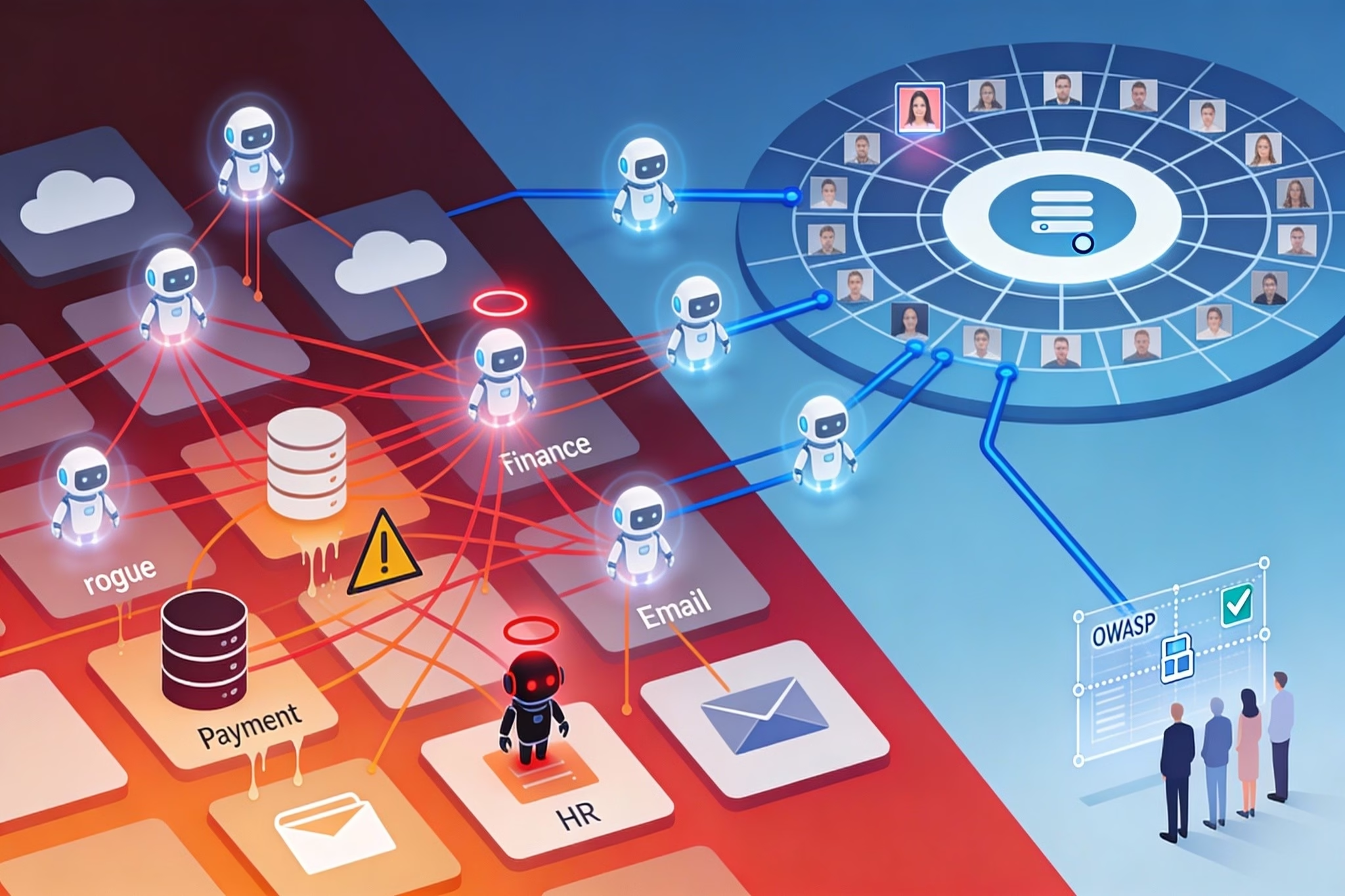
Agentic AI in the Enterprise: The Security Guide Nobody Gave You
Kasey Cromer, Netlok | January 27, 2026 Executive Summary Autonomous AI agents are now executing cod[...more]
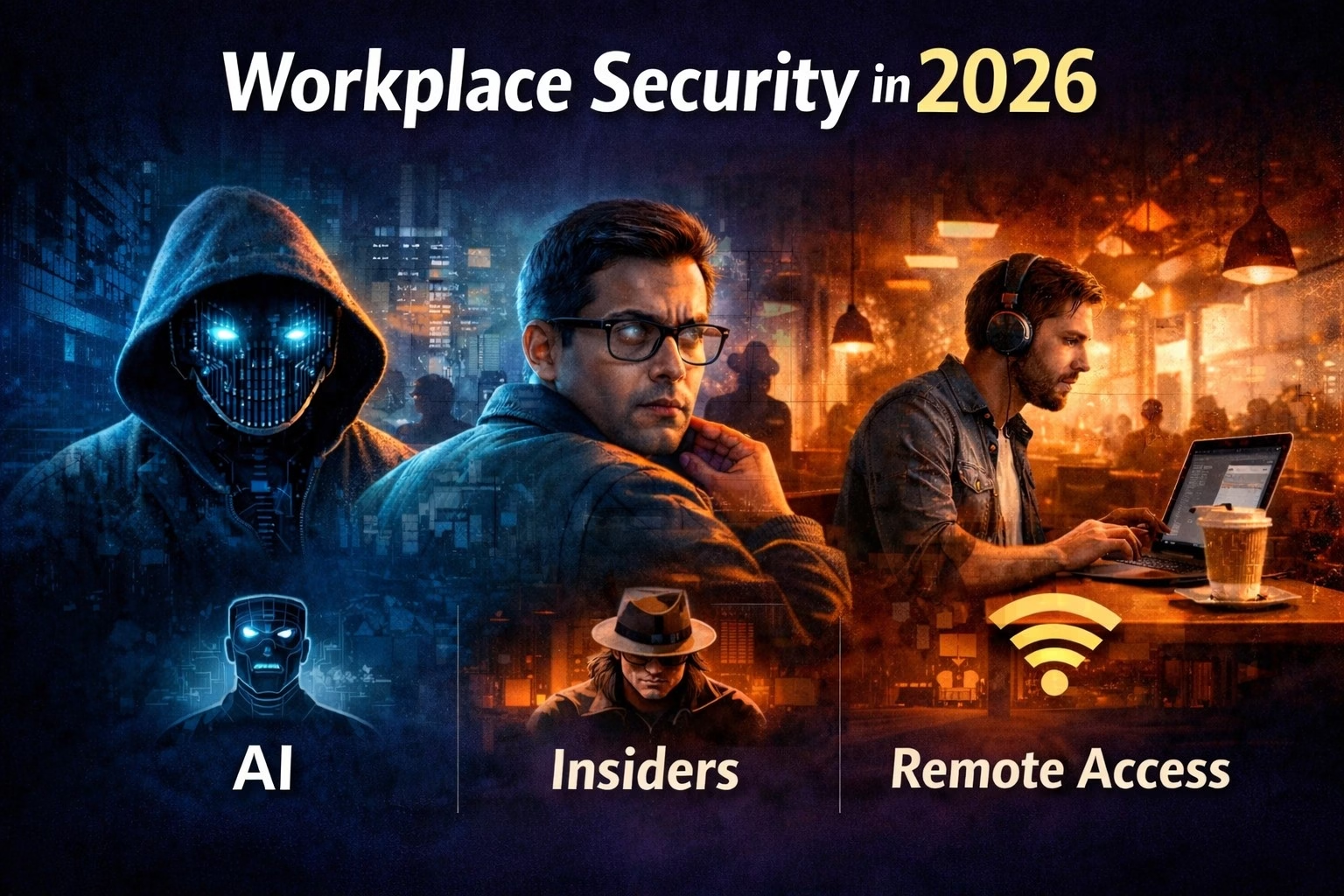
Workplace Security in 2026: When AI, Insiders, and Remote Work Collide
Kasey Cromer, Netlok | January 15, 2026 Executive Summary The uncomfortable truth about workplace se[...more]
How Insider Threats Bypass Security: Why Traditional Authentication Fails in the AI Era
Kasey Cromer, Netlok | January 5, 2026 Executive Summary Insider threats now cost an average of $17.[...more]
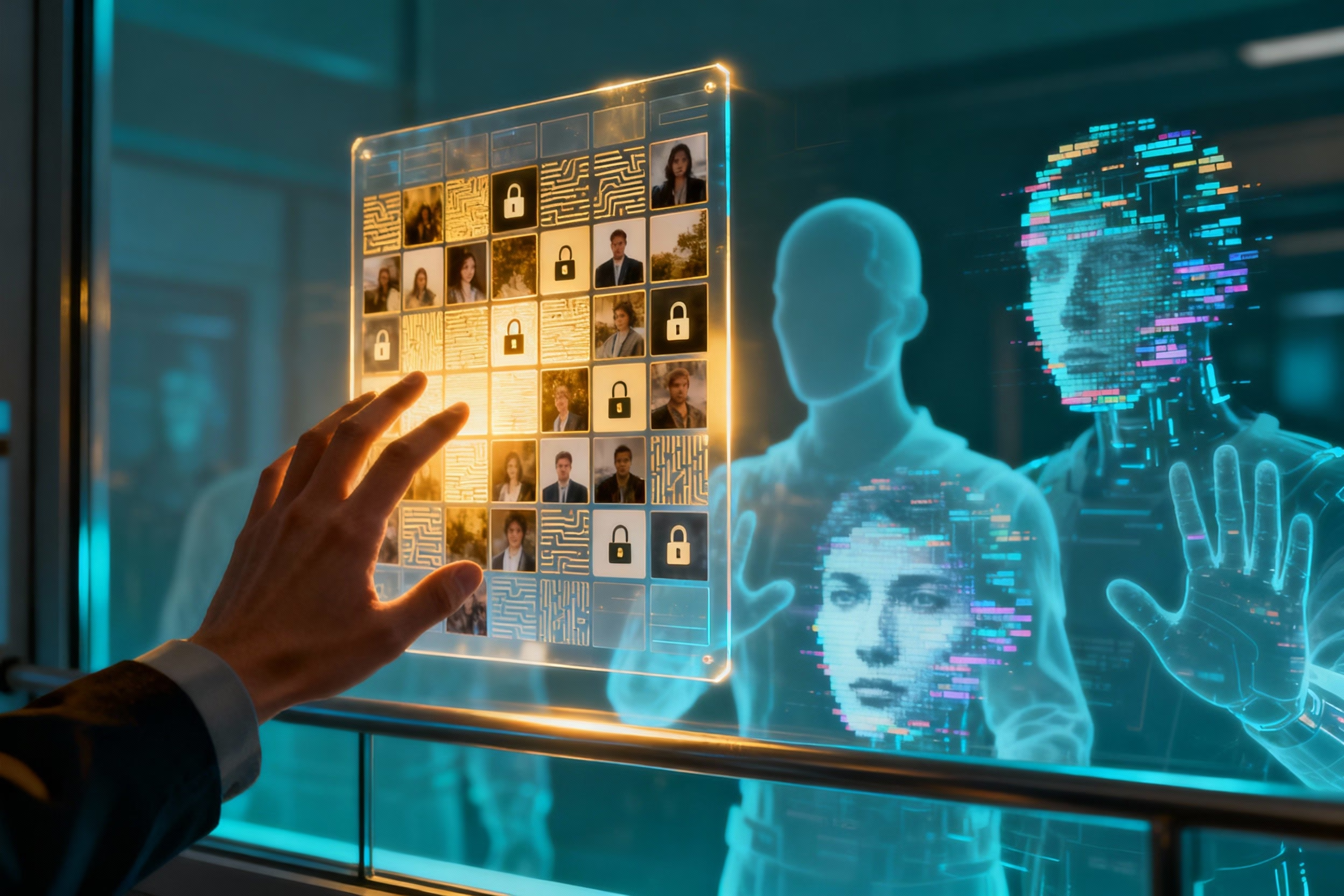
Authentication at a Crossroads: Preparing for the AI-Powered Threat Landscape of 2026 and Beyond
Kasey Cromer, Netlok | December 4, 2025 Series Recap Part 1 (November 14, 2025) took a deeper dive i[...more]

The $40 Billion Crisis: How AI-Powered Fraud Is Overwhelming Enterprise Security Teams
Kasey Cromer, Netlok | November 21, 2025 Executive Summary Global cybercrime is now a $10.5 trillion[...more]

AI Deepfakes: Enterprise Security Crisis Demanding New Authentication
Kasey Cromer, Netlok | November 14, 2025 Executive Summary A single deepfake video call cost a multi[...more]
